UK oncologists trust their MSLs more than any other pharma source, yet expect to see them less over the next two years as AI changes how they access information. Our latest Navigator365™ Sonar study points to three shifts Medical Affairs can make now: focus MSLs on scientific exchange that AI cannot replicate, make Medical the trusted source behind pharma’s own AI, and improve the visibility of reliable scientific evidence in public AI answers.
Oncologists value MSLs most, yet expect less contact as AI handles more routine questions
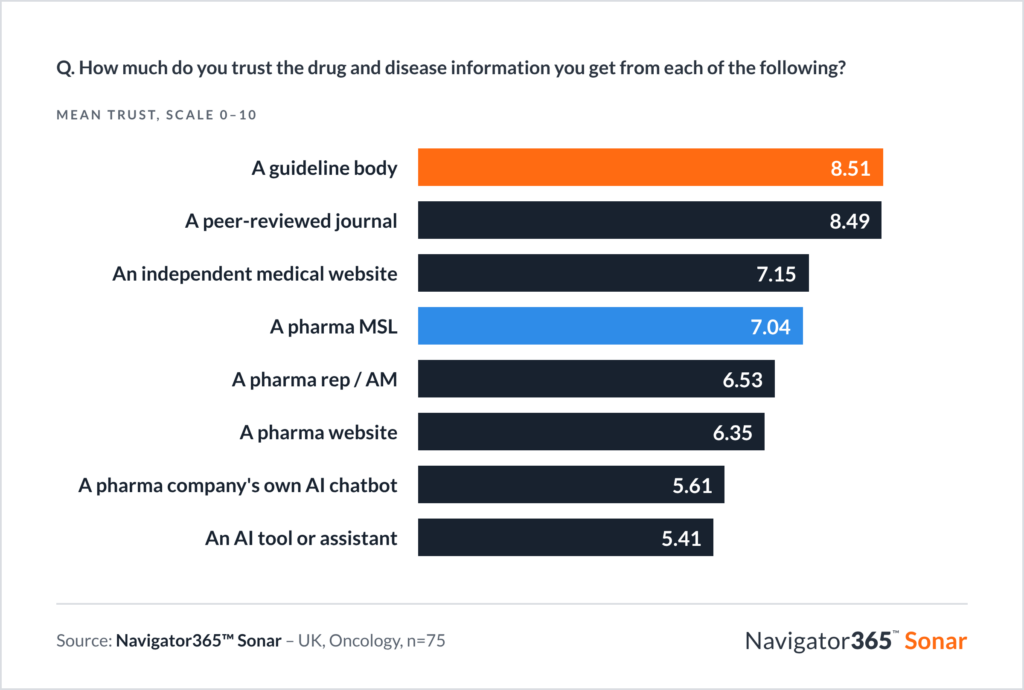
Ask UK oncologists which pharma source they trust most and the answer is the MSL, at 7.0 out of 10, ahead of reps (6.5) and pharma websites (6.4).
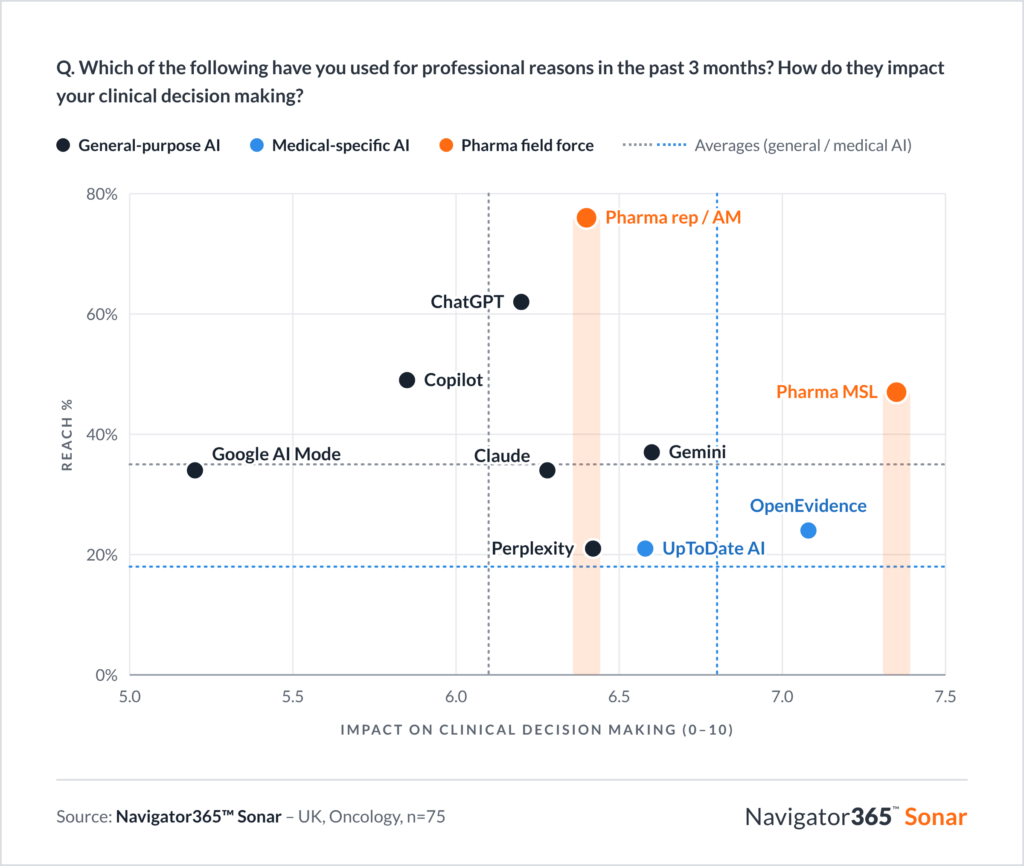
Among oncologists who used each source, an MSL scores highest on impact on clinical decisions at 7.3 out of 10, ahead of a rep at 6.4 and above both the general AI tool average (about 6.1) and the medical-specific AI average (about 6.8).
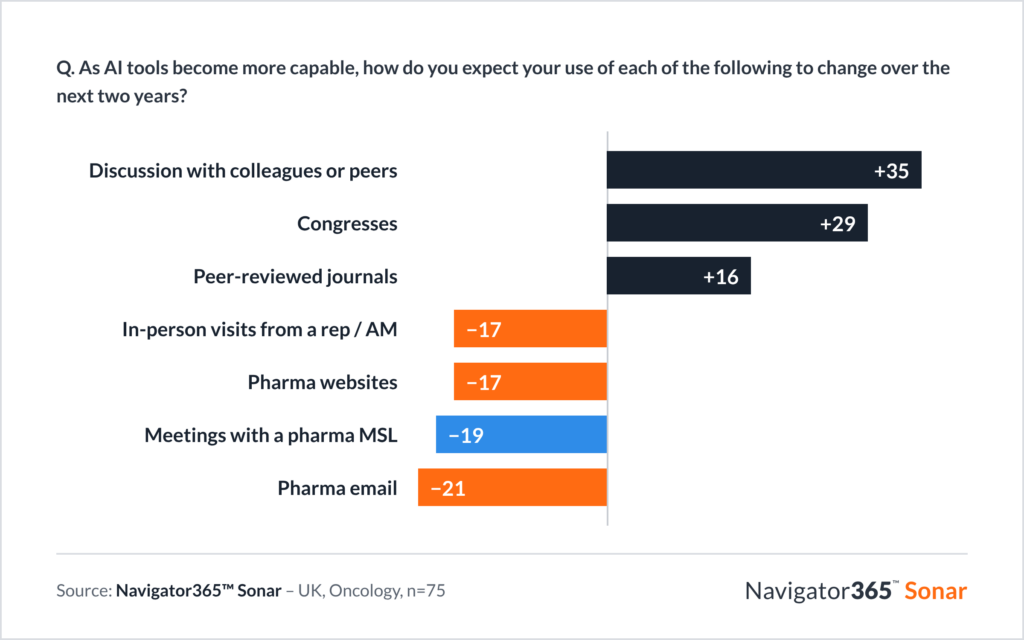
Yet more oncologists expect to meet MSLs less over the next two years than expect to meet them more, a net change of -19. Meanwhile, discussion with peers (+35) and congresses (+29) are set to grow.
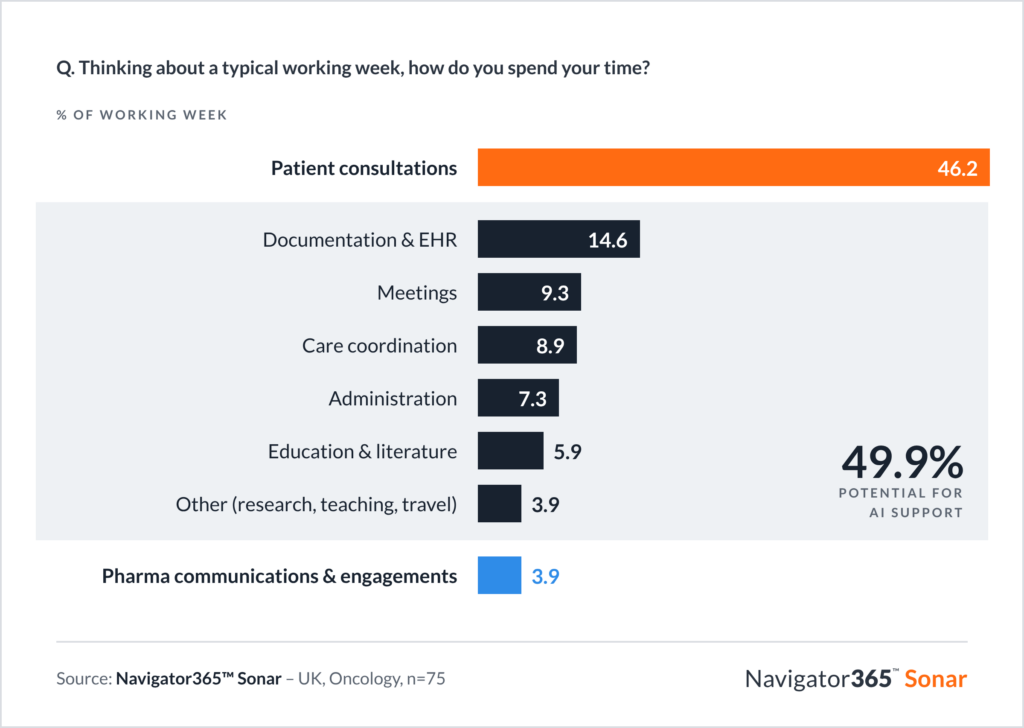
Time is one pressure. UK oncologists spend 46% of their working week in patient consultations and another 40% on documentation, meetings, care coordination and administration. Just 3.9% goes to pharma engagement: that’s about 1.6 hours in a 40-hour week, across every company and channel.
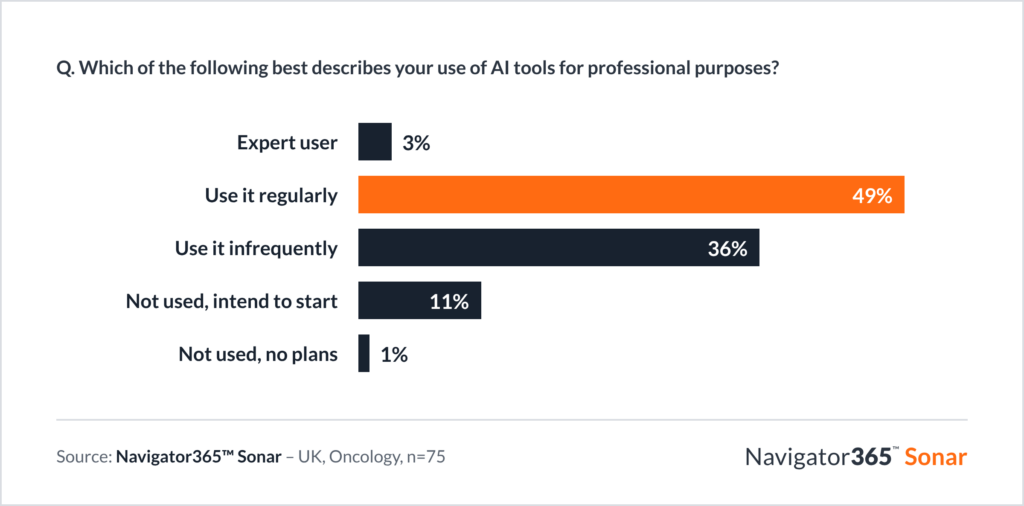
The second is AI. 88% of UK oncologists use AI tools professionally, and 52% use them regularly.
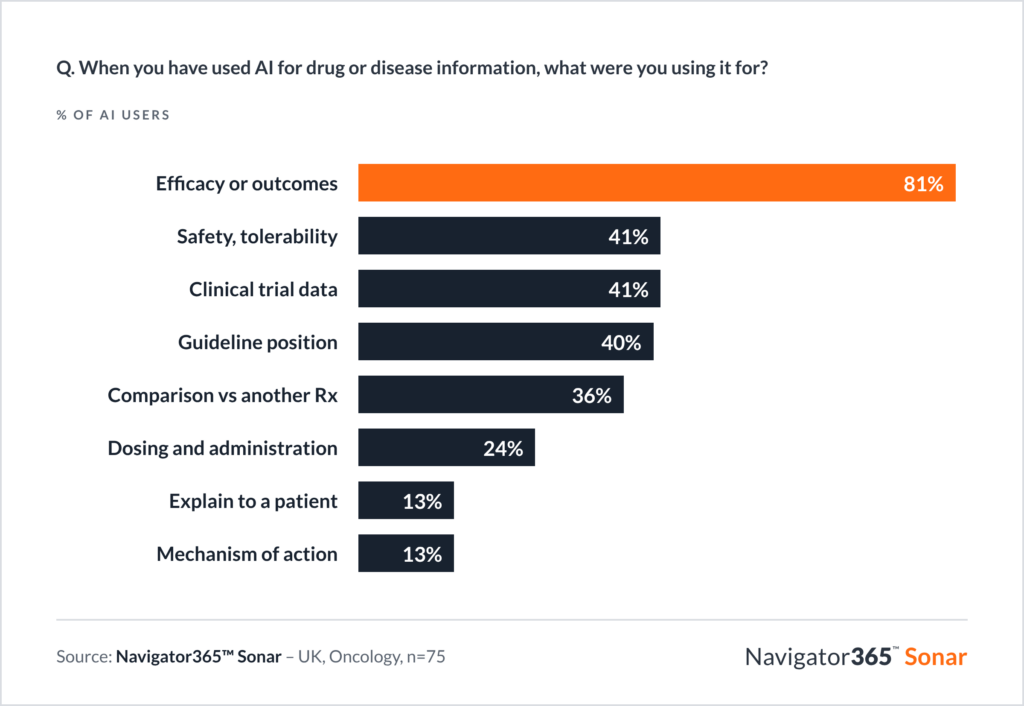
And they use AI for many of the scientific questions traditionally put to MSLs. Four in five (81%) look up efficacy or outcomes. Around two in five use it for safety and tolerability (41%), clinical trial data (41%) and guideline position (40%), while 36% compare treatments.
The question for Medical Affairs is therefore not whether the MSL role changes, but how. Our data points to three shifts.
Shift one: Focus MSLs on what AI cannot provide, and measure the insights they bring back
MSLs obviously do more than just deliver information. Their role includes scientific exchange, insight gathering, supporting research and evidence generation, and connecting oncologists with experts. AI is increasingly taking on routine information retrieval.
An MSL who simply relays published data competes with a tool that is free, instant and always available. With less than 4% of an oncologist’s working week available for pharma engagement, every minute matters. MSLs need to offer something genuinely valuable.
Four areas stand out where MSLs can add value:
- Scientific information for complex cases. When patients fall outside trial populations, progress early or guidelines are unclear, oncologists may need additional evidence. MSLs can respond to scientific questions, including appropriate unsolicited requests for data on file, with the necessary context, limitations and caveats. Clinical decisions remain with the treating team.
- Information AI cannot access. Unpublished analyses, emerging evidence and updates on ongoing trials may not be available to public AI tools. MSLs can share information where permitted, in response to appropriate requests and within medical and compliance requirements.
- What peers are actually doing. Discussions across centres give MSLs a view of real-world scientific questions, evidence gaps and changing practice that no single clinician or public AI tool can easily replicate.
- Access and connections. MSLs can facilitate access to company scientific experts, relevant external specialists, clinical trial information and research collaborations.
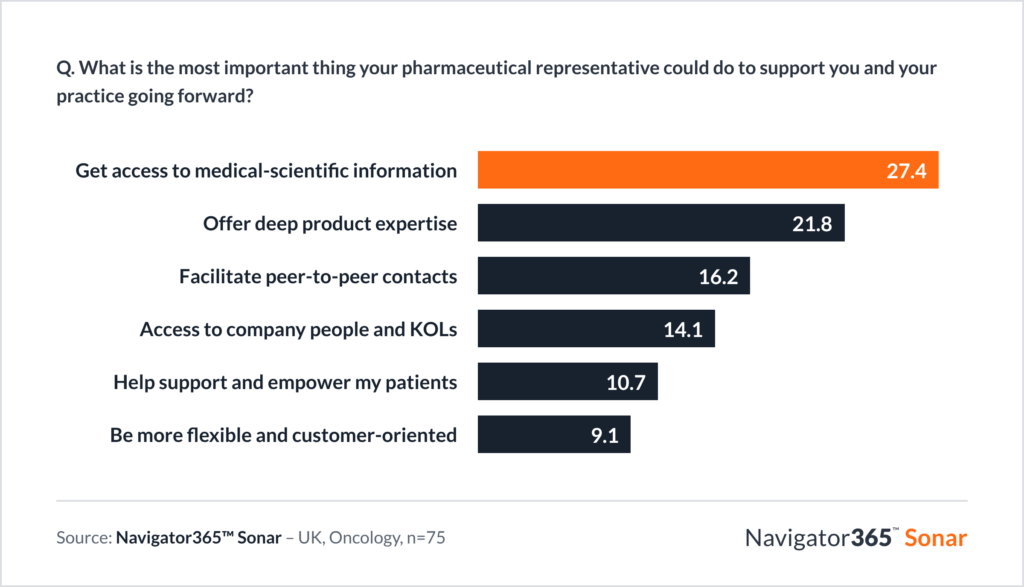
The data points in the same direction. Discussion with peers is the source oncologists most expect to use more (+35). Asked what reps could do to support them, oncologists prioritised access to medical-scientific information (27.4 of 100 points), deep product expertise (21.8), peer contacts (16.2) and access to company experts and KOLs (14.1).
These scientific exchanges also generate insights for Medical Affairs: where evidence is thin, which questions keep arising and what further research would be useful. The aim is not to extract information from oncologists, but to make the exchange valuable and use the resulting insights to improve evidence generation and scientific support.
This is consistent with the 2026 MAPS Benchmark Report’s emphasis on outcomes rather than meeting counts1, and McKinsey’s view that Medical Affairs can add value through tailored, data-backed scientific exchange2.
What to do now: assess both the value of scientific exchange for HCPs and the quality of insights that inform Medical strategy, rather than meeting counts alone. Equip MSLs with access to appropriate evidence and scientific expertise, and support them in handling complex questions within compliance boundaries.
Shift two: Make Medical the trusted source behind pharma’s own AI
Three quarters of oncologists (76%) say they would definitely or probably use a pharma-owned AI assistant (13% definitely, 63% probably), although only 3% used one in the last three months. Their support comes with conditions: 76%want it to cite its sources, 59% want Medical Affairs to oversee it and 56% want it to be honest about competitors.
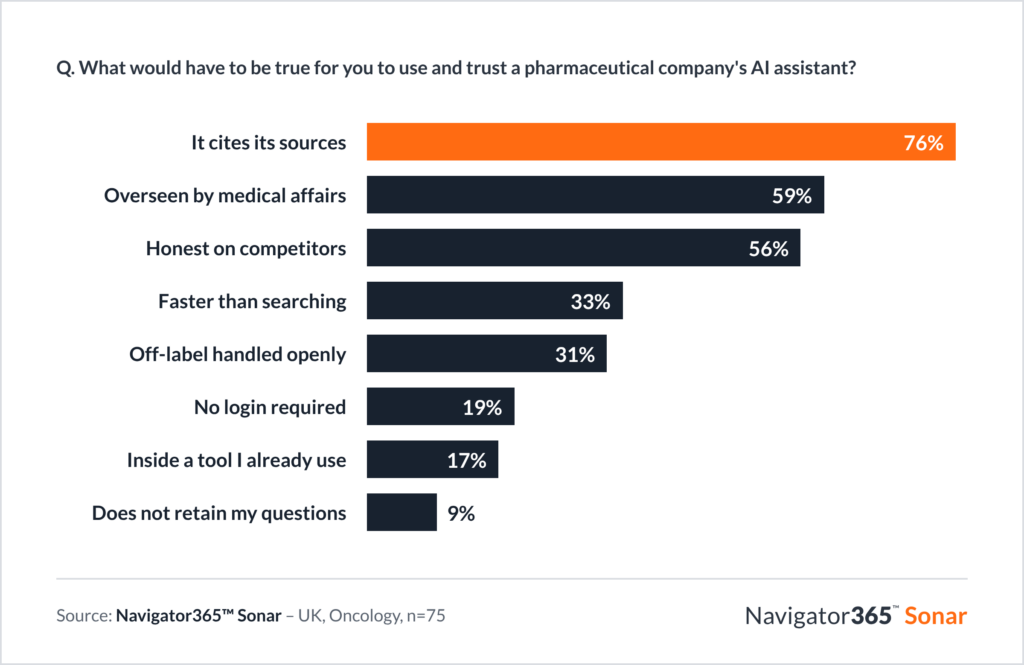
What to do now: own the governance of HCP-facing AI from day one. Oncologists have already told us what earns their trust: sources, Medical oversight and fair balance.
Shift three: Make your best evidence visible to public AI, and measure share of answer
Oncologists are increasingly turning to public AI for scientific questions. These tools do not necessarily access, verify or cite the original evidence accurately, and information behind password-protected HCP portals simply does not exist. Medical Affairs can help make accurate, balanced, non-promotional scientific information publicly accessible where permitted. This is generative engine optimisation (GEO), but it must operate within strict compliance rules. Public content about prescription medicines is subject to promotional and off-label restrictions (in the UK, the ABPI Code3; across Europe, EFPIA and national rules4). Medical, legal and regulatory review remains essential. The aim is to make reliable evidence findable, not to use AI answers to promote a product.
That also suggests a new measure. Share of voice captures a brand’s presence across channels, from field visits and email to websites, webinars and congresses. Share of answer asks a different question: when an oncologist puts a scientific question to an AI tool, is relevant evidence represented, accurately and in context? That includes appropriate sources, guideline positioning, limitations and fair comparisons with alternatives, not simply whether a brand is mentioned.
What to do now: review whether public AI tools can find and accurately represent your published scientific evidence. Track share of answer alongside share of voice, and ensure any new public content has passed the appropriate compliance review.
As with earlier channels, AI will change the MSL’s role rather than end it
Riepl’s law, formulated in 19135, holds that new channels rarely kill off the old ones. Instead, they push them into new roles. The MSL looks set to follow the same pattern. As AI takes on more routine scientific information retrieval, the value of MSLs will increasingly lie in the quality of scientific exchange, access to expertise and the insights those conversations generate.
Understanding how HCP behaviour is shifting is essential to making that transition. That is what our Navigator365 Sonar studies are designed to track and turn into practical recommendations.
About the study: Across Health Navigator365 Sonar, UK oncology. Online survey of 75 UK oncologists, fielded in September 2026.
Interested to see how your HCP target audiences compare?
These findings show how UK oncologists see MSLs, AI and pharma engagement today. Navigator365 Sonar shows you how the same shifts play out for your specialty and your markets, and what that means for your Medical Affairs priorities.
Book an exploratory demo call with one of our experts to see how Sonar works, what it can tell you about your HCPs, and how to apply these findings to your own plans.
We will be attending and discussing these findings at NEXT CX & AI (Oct. 27-28, 2026) in Vienna. If you work in Medical Affairs, commercial or AI strategy, we would welcome your view and a coffee in Vienna next week.
References
- [1] Medical Affairs Professional Society (MAPS). 2026 Annual Benchmark Report. MAPS; 2026.
- [2] Algazy J, Garcia A, Ryan S, Westra A, Zemp A. A vision for medical affairs 2030: Five priorities for patient impact. McKinsey & Company; 11 October 2023.
- [3] Association of the British Pharmaceutical Industry (ABPI). ABPI Code of Practice for the Pharmaceutical Industry 2024. Administered by the Prescription Medicines Code of Practice Authority (PMCPA); in operation from 1 October 2024.
- [4] European Federation of Pharmaceutical Industries and Associations (EFPIA). EFPIA Code of Practice.
- [5] Riepl W. Das Nachrichtenwesen des Altertums mit besonderer Rücksicht auf die Römer. Leipzig: Teubner; 1913.