
Doing the wrong thing well
Peter Drucker said it in one line: there is nothing so useless as doing efficiently that which should not be done at all. Pharma omnichannel is busy proving him right.
Effectiveness asks whether we are doing the right things: which brands, segments, specialties, channels and moments get money at all. Efficiency asks whether we are doing things right: personalization, content, timing, channel-mix tuning, more return from money already committed.
Why omnichannel confuses the two
Almost every omnichannel investment of the last five years sits on the efficiency side: next-best-action, modular content, send-time optimization, journey orchestration. All of it makes a euro work harder. None of it asks whether the euro should have been spent there.
The reason is structural. Efficiency lives in CRM and related technologies, with a myriad of internal data and wins showing up within a quarter. Allocation lives in the brand plan and fieldforce strategy, where outside-in evidence is thin and last year’s split is mostly inherited. So teams tune the open rate on an email that reaches 12% of the specialty, while the rep budget was set by headcount history. Efficient waste: green on every dashboard, flat at brand level.
Where Navigator365 Benchmark sits
The Across Health Navigator365 Benchmark covers both the effectiveness and efficiency questions in a brand-level competitive setting. The diagnostic framework runs from channels and frequency to share of voice and cost-to-serve, then content, then CX and its drivers, then customer perceptions and prescribing outcomes.
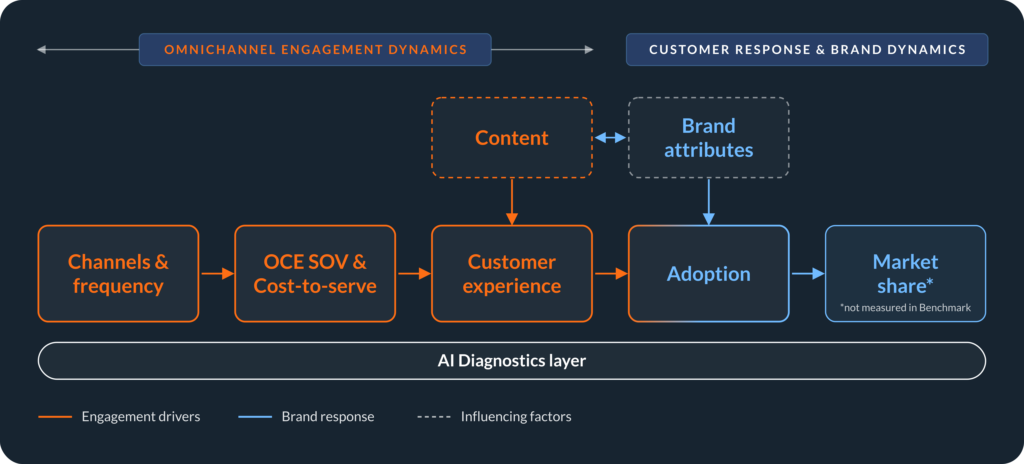
Navigator365 Benchmark 4D diagnostic framework
Effectiveness: is the money in the right place?
Three reads. First, share of voice against cost-to-serve: a brand buying its voice in expensive, low-impact channels is an allocation laggard before a single email is optimized. Second, outside-in: the same physicians report every competitor’s mix, so you see where rivals are winning share of voice and CX, and what it takes to play there. Most budgets still skip this step: 94% of EU biopharma call external benchmarking relevant, but only 8% do it routinely. Third, deaveraging: cutting the chain by practice size, adoption stage or any other segment shows where the brand is well allocated and where it is not, which is how you choose must-win segments instead of spreading spend evenly.
Efficiency: is each funded channel doing its job?
For each channel the brand uses, physicians rate content, relevance and quality against competitors on that same channel. The output is a start, stop, boost or reduce call for key investments: at the channel level, but also at the segment level.
In practice
Real Benchmark data, brands anonymised. Brand B has the largest omnichannel share of voice in its market, 24.4%, just ahead of Brand A at 23.5%. On the dashboard, B is winning. The physician disagrees: A has wider Rx breadth (26.3% vs 21.9%) and an NPS of +28 to B’s +12. Same volume, very different quality of voice.
Deaverage by practice setting and the allocation story appears. B is liked in private practice (NPS +35 against A’s +18) and rejected in hospital (−11 against +26). B is budgeting for share-of-voice leadership it already holds on average, and losing where it matters: in hospital, the money arrives and nobody is listening.
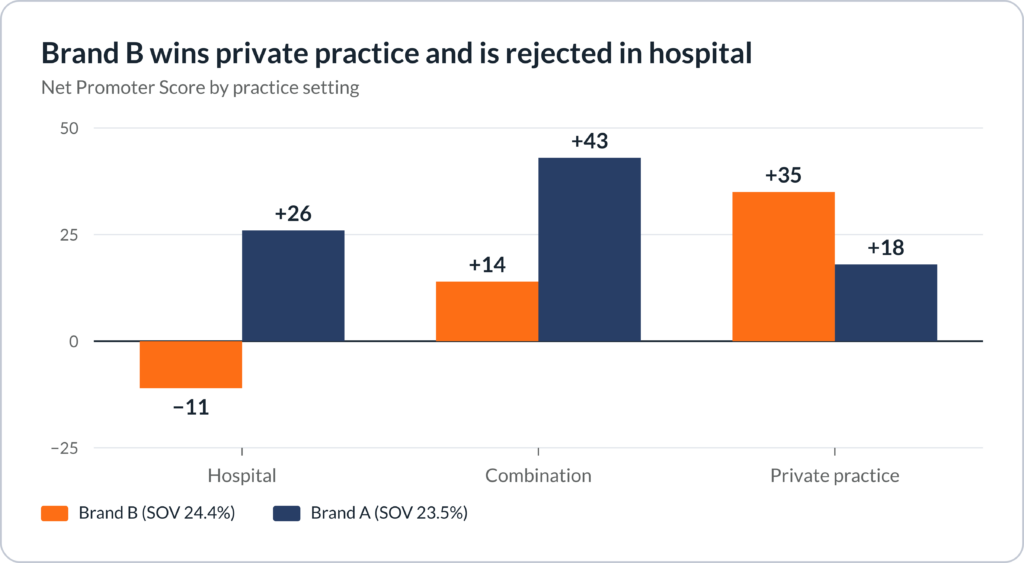
Navigator365 Benchmark data (anonymised)
The fix is not a better email. Protect the private practice as the must-grow segment, investigate what A does in hospital that B does not and optimize your hospital mix.
THE AI DISRUPTOR: ALLOCATIONS NOW HAVE AN EXPIRY DATE
Navigator365 data (75 UK oncologists) show how fast the ground is shifting. 88% already use AI tools professionally, 52% regularly. General-purpose LLMs reach 85% of them, ChatGPT alone 79% of AI users; medical-specific LLMs reach 35%.
Asked how AI will change their use of each source in the next 2 years, oncologists expect to lean more on peers (+35 net), congresses (+29) and journals (+16), and less on third-party medical media (−31), and pharma channels (email, MSL, websites and reps – from -17% to -21%). The money most at risk sits in media, pharma email and web.
When to shift is a tracking question. It is still early days: AI reach has moved, its weight in clinical decisions has not yet. But in times of change you need to fund experimentation now (McKinsey’s rule of thumb is 10% of the budget on innovation) and be prepared to switch substantially once AI has become the new normal. The signal to watch is when AI’s weight in clinical decisions catches up with its reach. Navigator365 Sonar, our ongoing tracker of how HCPs use different channels to stay informed, lets you track both, wave on wave.
Allocate first, then optimize hard
This is not an argument against personalization or orchestration. It is an argument about sequence. Ask any omnichannel roadmap one question: where is the allocation checked against the customer and the competition? If nowhere, it is optimizing a ceiling it never measured.