
In our first blog,1 we confirmed in an evidence-based way that omnichannel is a key driver of CX in biopharma – and that CX, in turn, is a critical component of NPS and brand performance. In our second blog,² we zoomed in on the importance of a multimetric mindset, i.e., a balanced set of CX KPIs. In this third essay, we look at how to activate the findings of external Benchmarking to ensure continuous improvement
Before we get started, a quick refresher…
1. CX is a business-critical driver: 60% of brand NPS in pharma is driven by CX factors vs. 40% by product features – and brand NPS is a strong predictor of market share;
2. Omnichannel has a measurable impact on CX;
3. Internal assessments are not sufficient: the CX perception gap (what companies think vs. what their customers think) remains large (50%+);
4. There is no single actionable KPI for CX – a balanced multimetric setup covering content & channel effectiveness, CX drivers and NPS leadership is required;
5. Numbers tell you what is happening, not why: a test-and-learn predictive framework is needed.
Moving beyond “scorecard CX”
The saying goes: “What gets measured, gets done.” However, in pharma CX programmes, data readouts followed by a strategic workshop often become the endpoint – while fully operationalising the findings rarely is. Yet Benchmarking is not a “nice to have”: it should be followed by prioritised actions, which are then measured and iterated upon in a virtuous cycle. The real advantage of Benchmarking comes from rallying teams, aligning culture and systems, and learning from execution. The opposite is “scorecard CX,” where insights are collected but not activated, resulting in misalignment and loss of momentum.
“Organisations that win on CX will be the ones that don’t just analyse experience but activate it every day, across every function.” – S. Albertson³
HOW OFTEN should you benchmark?
Because analysis should be followed by action, the ideal frequency depends on how fast priority changes can be deployed to customers. If meaningful change can be implemented within ~4 months, benchmarking should ideally take place 2–4 times per year, with full benchmark waves complemented by intermediate “light” waves that reassess focus areas and key KPIs – always including the competitive landscape.
If your implementation cycle is more like 8–10 months, annual benchmarking may be sufficient, but it risks leaving you blind to competitor changes and slowing momentum in the field.
AT WHICH STAGE(S) in the product life cycle should you benchmark?
Benchmarking CX and its key drivers – from channel mix to content and CX drivers – can deliver competitive advantage throughout the product life cycle, but value peaks at specific stages:
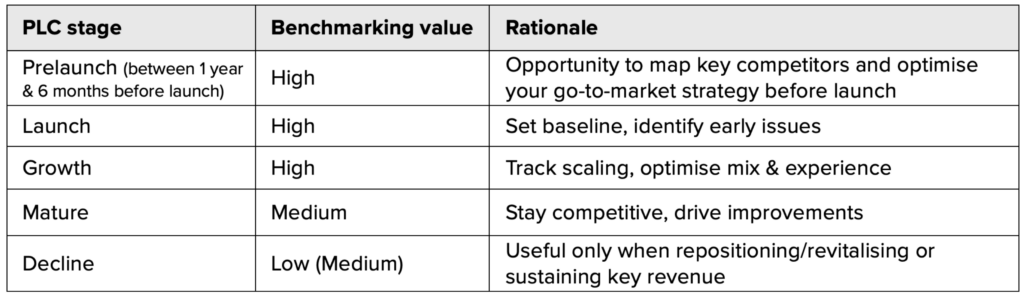
The prelaunch phase may seem surprising given limited brand data, but it is ideal for observing competitors and shaping launch readiness.
A second benchmark shortly after launch helps validate early experience and channel/content effectiveness with both prescribers and non-prescribers.
Growth-phase benchmarking helps optimise scaling, track new entrants, and stay ahead of market shifts.
In mature/decline, benchmarking is deprioritised, unless:
- There is meaningful “new news” (e.g., new indication, strong repositioning), or
- The brand still represents significant revenue and benefits from an evidence-based omnichannel NPP strategy.⁴
Where relevant, increasing pulse frequency helps accelerate course correction – for example, some launch brands run up to four waves per year because the first year is highly predictive of peak sales.
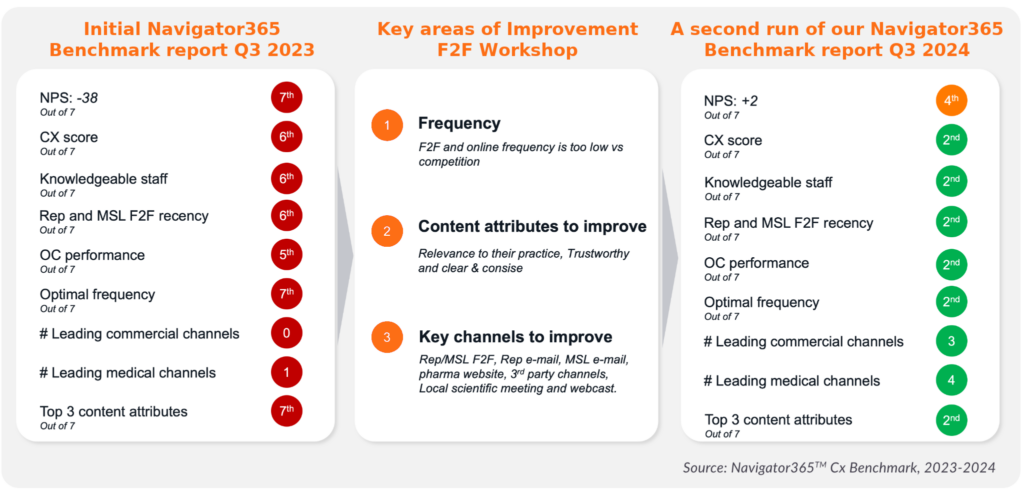
Across Health case study (Launch)
Across Health supported the launch of a drug in a highly competitive specialist market.⁵ A baseline benchmark was followed by strategic prioritisation and execution. A second benchmark conducted one year later showed strong improvements across all key CX parameters. Priorities were reset again with full leadership backing – establishing a repeatable cycle of learning and performance growth.
Side note: the role of AI in Benchmarking
With AI influencing many business decisions, three key questions arise:
- Can AI predict brand and competitor CX?
No, the granular, longitudinal data do not exist publicly or internally at sufficient scale. And even with such data, human strategic choices and execution quality remain unpredictable - Can you assess how competitors are using AI in their go-to-market model?
Only indirectly (e.g., improved personalisation or orchestration). Most AI impact is not outwardly visible. - Can AI improve CX?
Yes, when used responsibly to enhance personalisation, automation and insight generation. However, challenges such as potential customer confusion/dissatisfaction through inadequate use of AI, as well as the need for algorithm transparency and privacy must be addressed.
Conclusion
Across this three-part series, we have seen that:
- External benchmarking provides the necessary outside-in reality check;
- A balanced multimetric CX model clarifies what to measure;
- And now, effective execution drives continuous improvement and performance impact.
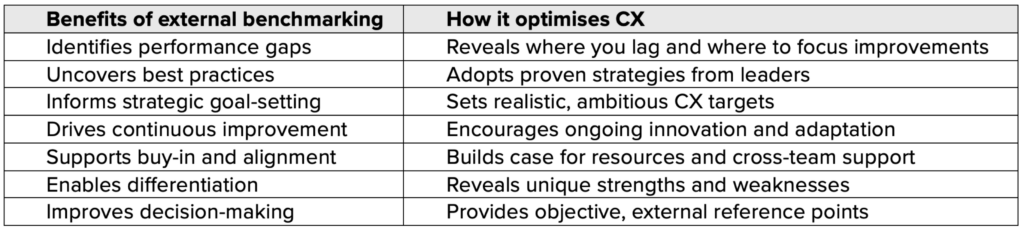
Hopefully it has become abundantly clear that this discipline holds a lot of potential for ambitious, evidence-based biopharma brand leaders and related functions. Indeed, external benchmarking is a catalyst for CX optimisation by providing clarity, direction and actionable insights. It empowers organisations to learn from the best, set meaningful goals, and foster a culture of continuous improvement and customer-centricity.
“Being at least as good as the leader is a prerequisite to being competitive.” – Peter Drucker
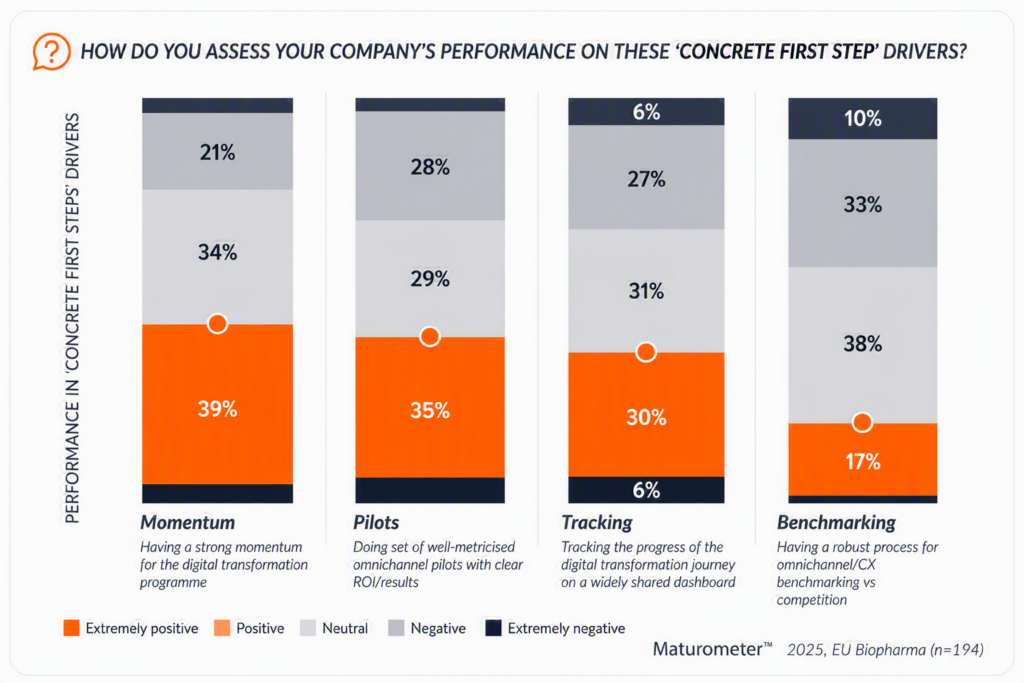
Yet adoption in biopharma remains slow: in the 2025 Across Health Maturometer,⁶ fewer than 20% of respondents expressed confidence in their company’s external benchmarking approach.
However, according to BCG,⁷ pharma brands can increase sales by up to 15% when combining marketing-led and sales-led CX improvement. Establishing a test-and-learn culture is key: improvement happens through iteration, not overnight perfection.
Whether optimising content, omnichannel mix or CX drivers, external Benchmarking equips teams to act with confidence. At Across Health we can support the full process: research design, insight readouts, strategic prioritisation, execution and impact measurement.
We wish you every success on this fun and strategic journey!
Navigator365 Benchmark 4D is a brand-level competitive diagnostic that connects omnichannel execution, customer experience, brand attributes, and adoption dynamics across the competitors that matter most. If you would like to learn how these uniquely actionable insights can help shape your customer engagement strategy, book a call with one of our experts.
References
- Schenck, F., June 2025: How to bridge the CX perception gap through robust external benchmarking.
- Schenck, F., October 2025: How to identify actionable and impactful Benchmarking KPIs.
- Albertson, S., October 2025: The End of Scoreboard CX. Available at: https://www.cmswire.com/customer-experience/the-end-of-scoreboard-cx-why-customer-experience-needs-movement-not-metrics/
- Smet, B., October 2025: How we replaced 70,000 rep visits with an omnichannel strategy – and drove double digit growth.
- Geysen, S., May 2025: Driving biopharma brand success with benchmarking insights and collaborative action.
- Geysen, S., October 2025: Inside the Maturometer 2025 report.
- D’Avanzo, I., et al., November 2023: Rethinking Pharma’s Commercial Model. Available at: https://www.bcg.com/publications/2023/rethinking-pharma-companies-commercial-model