
Ask any customer-experience leader whether benchmarking matters, and the answer is almost always yes. In CustomerGauge’s 2026 NPS Benchmark Report1, CX leaders rated its importance 8.5 out of 10. Yet one in five doesn’t benchmark at all, and only 16% use a third-party provider. Everyone wants to know “is my number good?” — and almost no one has a rigorous way to answer it.
The pharma paradox, in numbers
In pharma the paradox is even sharper.
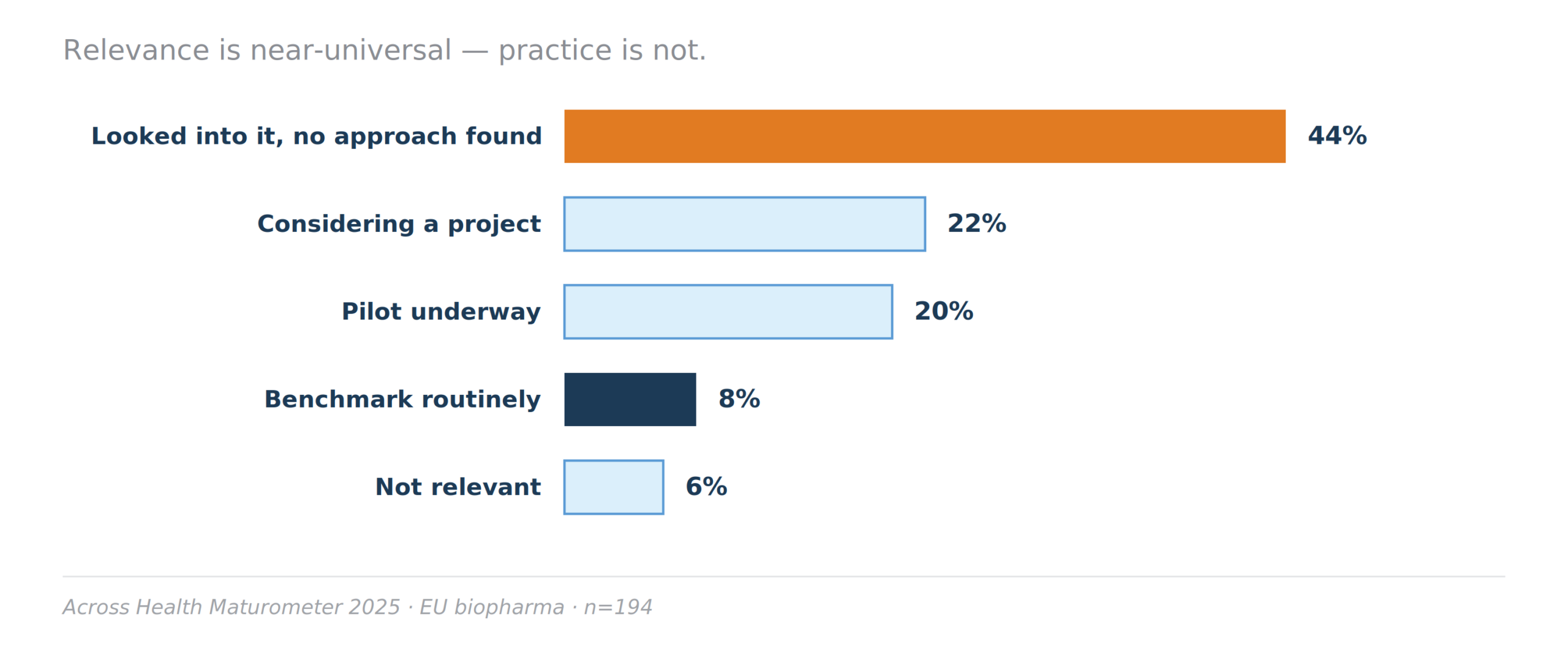
In Across Health’s 2025 Maturometer (EU biopharma, n=194)2, 94% consider external benchmarking relevant — yet just 8% do it routinely, and the largest group, 44%, have looked into it and not found a workable approach. Belief is near-universal; rigorous practice is rare; most have tried and stalled.
Figure 1. External benchmarking in EU biopharma
Why the gap persists: teams own the wrong benchmark
The benchmark most brand teams already commission — ATU tracking (awareness, trial, usage) — measures only the customer’s response, across the competitive set. Useful, but it says nothing about the engagement that has a big impact on adoption. So it never answers the budget question: are we getting enough return on what we spend, versus the competition?
The two sides of the chain
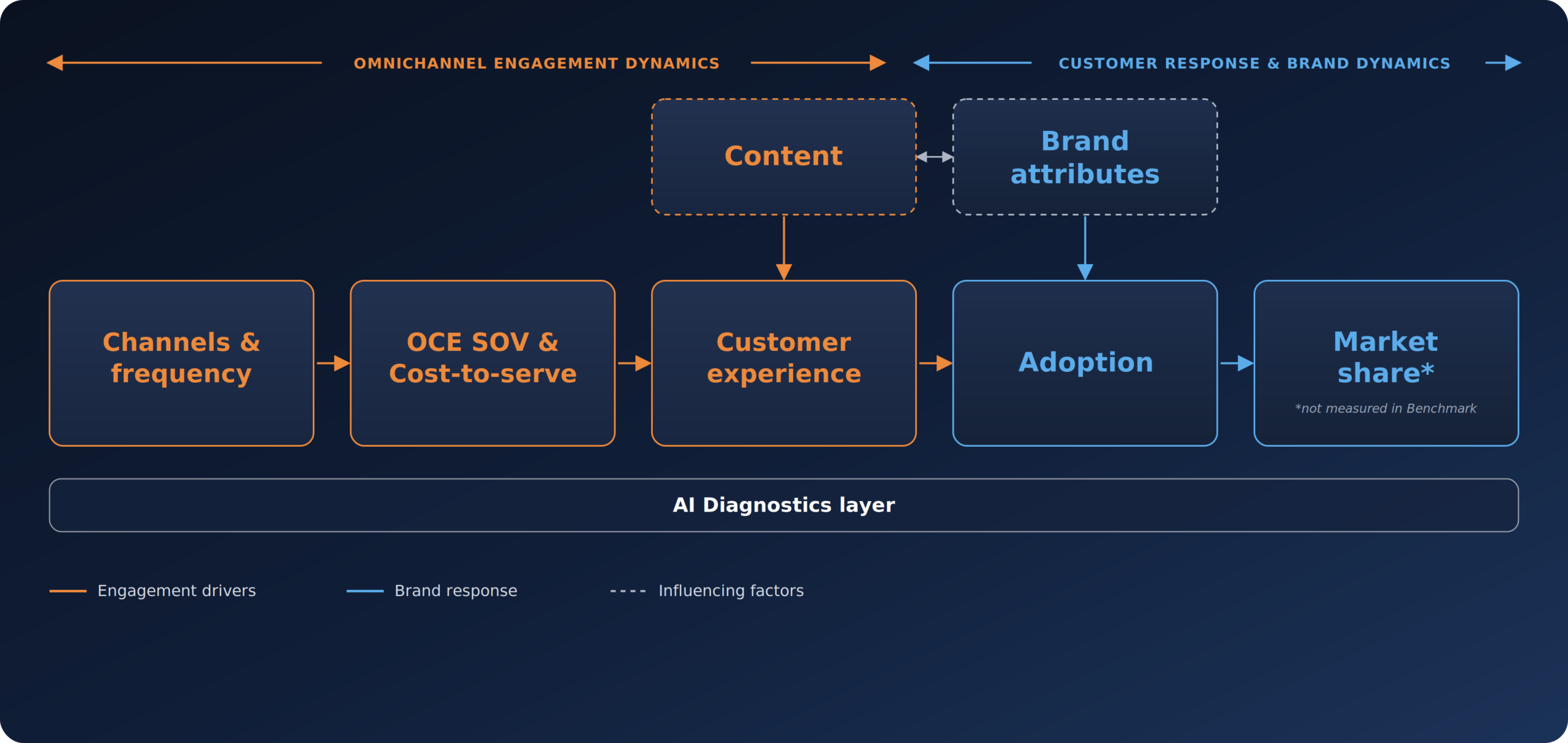
Picture this as a chain. The (orange) left side is how you engage — channels, reach, share of voice, cost-to-serve, customer experience. The (blue) right side is how customers respond — awareness, trial, usage, Rx intent, advocacy (NPS), and ultimately market share.
What robust external benchmarking should deliver
A number, however external, is only half an answer. Three properties, together: external — a genuine third-party comparator covering both the customer and competitor lens, since the internal view can be misleading; full-chain — engagement and response as one connected system, so a gap can be traced to its cause; and segmented — because the brand average is rarely anyone’s actual pattern. With all three in place, a benchmark becomes a basis for decisions: where in the chain the ground is lost, in which segment, and whether the driver is the product or the experience — and therefore what to start, stop, scale or pilot.
This full-chain, external, syndicated benchmark is what Navigator365 Benchmark 4D is built to provide: Data, Diagnostic and Decision – Deaveraged (segmented) against the named competitors that matter.
References
1. CustomerGauge. The NPS Benchmark Report: Decade Edition (2026), Finding Six — “The benchmarking paradox.”
2. Across Health. Maturometer 2025 — “Omnichannel transformation: where’s the industry at?” EU biopharma, n=194